What comes to your mind when you think of the Arctic? If your thoughts are centered on the fact that this region is one of the coldest regions of planet earth and it’s situated at the North Pole, then you are on track. However, another interesting fact about this region is that it acts as a sink for carbon/CO2 as well as a sink/source of seawater. Sounds fascinating, right? Well, there is even more, it is also a habitat for organisms like the polar bears, seals, and arctic fox. The list is inexhaustible.
Sea ice can remove CO2 from the atmosphere
Source: http://petrowiki.org/File:Types_of_CO2_sequestration.png

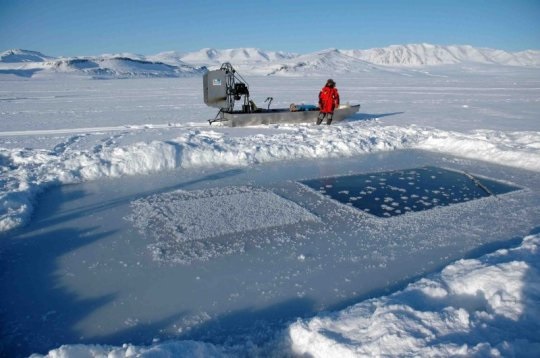
The very astonishing role of being a natural carbon sink is one that catches the eye, although this function is at the verge of being entirely disrupted, it still takes place. The whole process begins with carbon. Carbon is a major component of fossil fuels. When these fuels are combusted, carbon is released as carbon dioxide (CO2) and/or the infamous carbon monoxide (CO) as end products of the combustion process. Normally, CO2 doesn’t appear to cause any direct harm to humans; after all, it’s an end product of human respiration, and we even use it in some fire extinguishers. The problem here is tampering with the quantity of CO2 in the air. When the percentage of CO2 in the atmosphere exceeds the natural value of about 0.03%, no matter how small this increment may be, it leads to Global warming. The theory behind global warming is quite simple: CO2 and a host of other gases mimic a ‘greenhouse’. If you know how a greenhouse functions, then you will immediately get the picture. In fact, it is because of this mimicry that CO2 and the other gases like methane are called greenhouse gases: they cause global warming by making the earth one giant greenhouse or hothouse. They act as a blanket, trapping the long-wave infra-red radiation that is supposed to be reflected out by the earth’s surface. This results in global warming and its multiplier effects, such as melting polar ice caps, rising sea level, coastal flooding, and heat waves. Thankfully, there is a bright light at the end of the tunnel, apart from the capital-intensive Geoengineering processes (Mineral and Geologic sequestration) that are being used in a series of methods termed carbon capture and sequestration, there are natural processes that are very helpful in capturing and storing carbon: Terrestrial and Arctic carbon capture and storage. The terrestrial sequestration captures CO2 by using trees and plants through photosynthesis; the Arctic, however, has been doing its sequestration for ages. According to Dorte Haubjerg Søgaard, PhD Fellow, Nordic Centre for Earth Evolution, University of Southern Denmark, and the Greenland Institute of Natural Resources, Nuuk “The chemical removal of CO2 in sea ice occurs in two phases. First crystals of calcium carbonate are formed in sea ice in winter. During this formation, CO2 splits off and is dissolved in heavy cold brine, which gets squeezed out of the ice and sinks into the deeper parts of the ocean. Calcium carbonate cannot move as freely as CO2, and therefore it stays in the sea ice. In summer, when the sea ice melts, calcium carbonate dissolves, and CO2 is needed for this process. Thus, CO2 gets drawn from the atmosphere into the ocean; therefore, CO2 gets removed from the atmosphere.” This is one of several processes used by the Arctic in carbon sequestration.
However, with the current trend in the anthropogenic CO2 release and the consequent global warming, the Arctic’s ice cap is getting thinner, which means a continuous decrease in the ability of the Arctic to capture carbon. The Arctic may eventually become a carbon source. As bad as this may seem, some scientist are looking at the bright side to this, not like we want it anyway, but considering the fact that a warmer climate means increase in vegetation growth which in turn is another source of carbon sink (Terrestrial sequestration); one can only ponder at how efficient this would be in sequestering carbon when compared to the incredible Arctic.
Ikenna William Unadike